
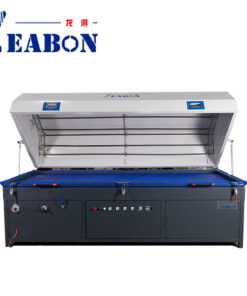
Vacuum membrane press machines from Leabon bond PVC, PETG, transfer film, leather, wall cloth and wood veneer onto flat or curved workpieces by combining heat with vacuum. A silicone membrane is drawn down over the panel by negative pressure and then pressed by positive pressure, so the film follows every profile without bubbles, wrinkles or lifted edges.
How a vacuum membrane press works
Panel and film go onto the worktable and the heating box closes over them. Infrared or thermal-oil platens soften the film, a vacuum pump evacuates the air beneath the membrane, and the membrane is pressed onto the workpiece. When the cycle ends the film is cut automatically and the panel is unloaded — on a dual-station machine the heating box moves straight to the second table, so loading and pressing never compete for the same minute.
Which vacuum press fits your production
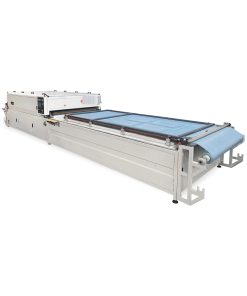
- PV-2500A Vacuum Membrane Press — compact 2550 x 1300 mm single-station press, 18.7 kW, the entry point into film lamination.
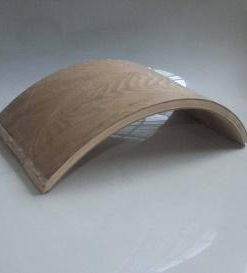
- PV-3000A Lamination Vacuum Press — Type A curved veneer press on a 3000 x 1300 mm table, the economical route into shaped work.
- PV-3000B Special-Shaped Vacuum Press — Type B with a lifting heating box, 300 mm processing height, for curved veneer and door cores.
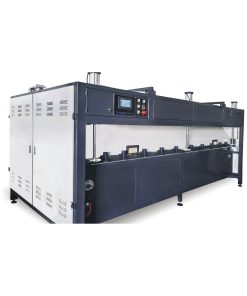
- PV-3013D Lamination Vacuum Press — 3000 mm dual station with infrared heating, 2.2 kW pump and 2300 kg frame.
- PV-3013E Lamination Vacuum Press — same table as the D, plus a 3.0 kW pump, two cooling fans and PVC correction devices.
- TM-3200G Lamination Vacuum Press — positive and negative pressure with oil-electric hybrid heating, 2580 or 3000 mm table, 500 t frame.
- TM2800 / TM3200 Positive-Negative Pressure Press — the earlier TM series with the same twin-pressure principle, still fully supported.
What these machines are used for
Kitchen and bathroom cabinet doors, wardrobe and sliding doors, interior doors, office furniture panels, shop fitting components, and curved or carved parts that a flat platen press cannot follow. The most common materials are PVC and PETG furniture film, transfer film, CPL, wood veneer, leather and wall cloth. Processing height runs from 40 mm on the TM-3200G to 300 mm on the PV-3000B, so thick profiled and hollow-core parts can be handled as well as standard 18 mm doors.
What decides the configuration and the price
- Table length and number of stations. A single 2550 mm table is enough for cabinet doors; 3000 mm twin stations are what high-volume door plants order.
- Heating. Infrared is fast to install and cheap to run; oil-electric hybrid heating costs more but holds ±1 °C on a 3 m platen and is about 40% more efficient than pure electric heating.
- Vacuum capacity. A 2.2 kW / 100 m³h pump covers standard film work; 3.0 kW and a larger tank shorten the forming stage on thick or large panels.
- Pressure principle. Vacuum alone forms the film; adding positive pressure presses it onto deep profiles with roughly 200 t of force, which is what makes carved doors possible.
Frequently Asked Questions
Q: Vacuum or membrane — same thing?
A: They are the same machine type: a silicone membrane plus vacuum forms the film over the profile.
Q: Is training included?
A: Yes — setup guidance, operation training and spare-part support are provided.
Q: What is the lead time?
A: Depends on platen size; contact Leabon with the model code for a confirmed schedule.
Q: Can one machine press both flat doors and curved parts?
A: A flat-bed press handles flat and lightly profiled panels. For curved veneer work choose the PV-3000A or PV-3000B, where the heating box lifts over a fixed platform.
Q: Which film thickness can be run?
A: PVC and PETG furniture film from 0.12 mm upward is the normal range; thinner film needs a lower temperature preset, and the PLC on the 3013 and TM series stores those presets as separate modes.
Not sure which model matches your panel size and output? Send the workpiece size, the film type and the daily volume to the Leabon sales team and you will get a configuration and a quotation for the exact machine.
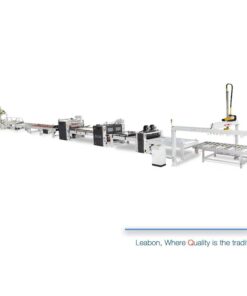
Equipment for Automated Production Line
Automatic PUR Hot Melt Laminating Line with Suction Cup Loader
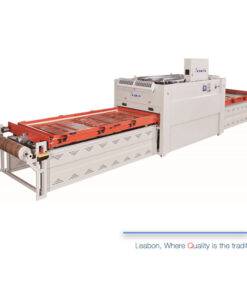
Press and Laminating Machine
Automatic PVC Vacuum Membrane Press for Doors, Cabinets and Panels
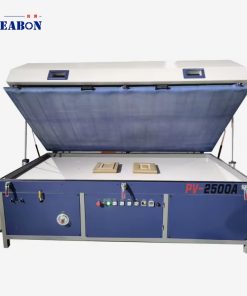
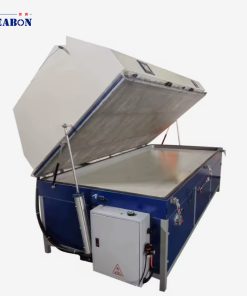
Vacuum Membrane Press
Vacuum Membrane Press
Vacuum Membrane Press
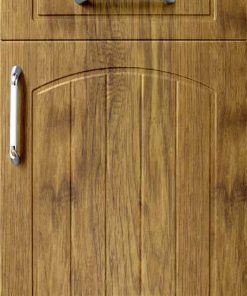
Vacuum Membrane Press
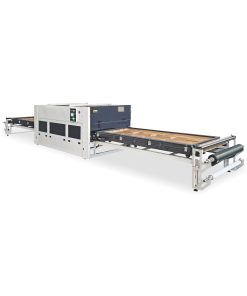
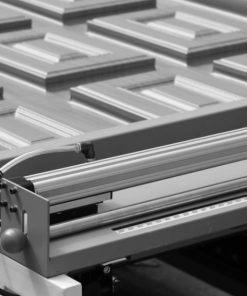
Vacuum Membrane Press
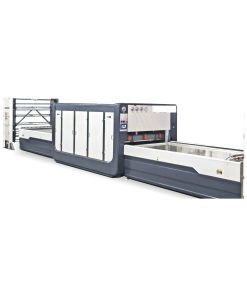
Vacuum Membrane Press
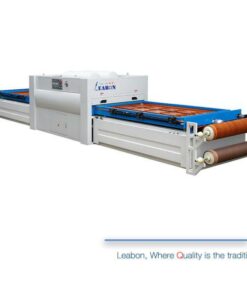
Carpentry Machine for Beginners
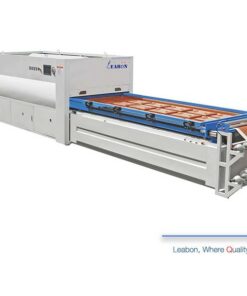
Vacuum Membrane Press
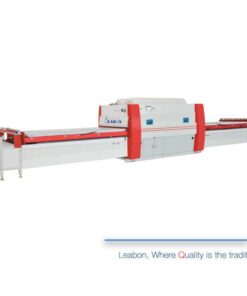
Vacuum Membrane Press

Vacuum Membrane Press
Vacuum press machine-positive and negative pressureTM2800/3200
Key Features and Benefits:
- Vacuum Technology: The machine creates a vacuum to hold the wood components securely in place during pressing, ensuring a strong and even bond.
- Heated Membrane: A heated membrane is applied to the wood, transferring heat and pressure to the materials being bonded.
- Multipurpose: Vacuum membrane presses can be used for a wide range of woodworking applications, including laminating, edge banding, and forming curved surfaces.
Types of Vacuum Membrane Presses:
- Negative Pressure Press: Suitable for common panel cabinets, wardrobe doors lamination, the vacuum pressure comes from bottom side only.
- Positive and Negative Pressure Press: Offer strong and powerful lamination solution for high glossy PVC, veneer etc. thick membrane materials.
- Manual Press: Good for high workpiece whose thickness is more than 50mm, up to 400mm, such as chair back, arc-shaped products etc