
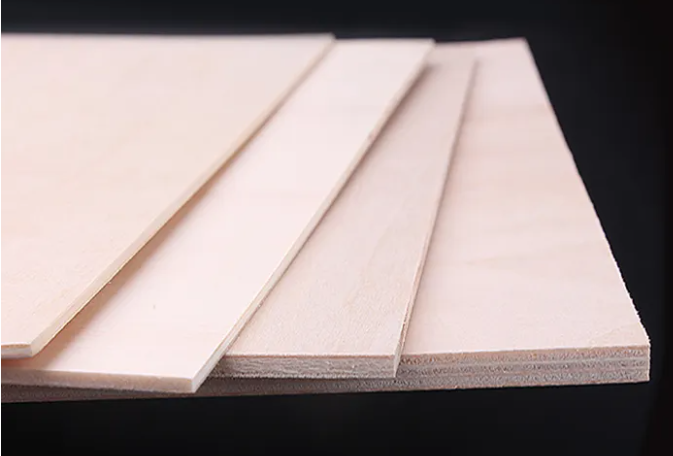
Veneer, with its lightweight texture and natural grain, has become an important material in the furniture and decorative panel industry. However, precisely because of its thinness, the splicing process has always been a technical challenge for manufacturers. Traditional veneer splicing methods often suffer from problems such as weak joints, visible glue lines, easy deformation, and uneven moisture content, which not only affect the aesthetics and quality of the product but also lead to low production efficiency and increased raw material waste.
With the continuous upgrading of manufacturing technology, a new generation of veneer hot-press splicing machines has emerged. With precise hydraulic control, intelligent control systems, and automated assembly line operations, it provides a stable and efficient integrated solution for veneer splicing.
01 Common Problems In Traditional Thin-Plate Splicing
In traditional thin-plate splicing processes, a series of problems have long constrained production quality and efficiency. These problems not only directly affect the aesthetics and structural strength of the products but also severely restrict production efficiency and cost control.
(1) Poor splicing, obvious glue lines
Uneven pressure output from traditional presses, especially at the joints, easily creates pressure “vacuum zones,” leading to insufficient bonding. Finished products often exhibit problems such as exposed glue lines and cracked joints, affecting structural strength and aesthetics.
(2) Highly susceptible to deformation and surface defects
Thin plates are extremely sensitive to changes in temperature and humidity, requiring high precision. Uneven heating or improper moisture content control during hot pressing can easily cause defects such as curling, wrinkling, and surface micro-cracks, increasing the rate of secondary processing or scrap.
(3) Low production efficiency, reliant on manual labor
From laying and alignment to pressing, traditional processes rely heavily on manual operation. The splicing cycle is long, labor-intensive, and difficult to achieve continuous, large-scale production, becoming a major bottleneck for capacity improvement.
(4) Poor adaptability and limited specifications
Traditional equipment has relatively crude pressure and temperature control for ultra-thin sheets (especially 2-8mm), making it difficult to adapt to the splicing needs of thin sheets of various sizes and materials, resulting in insufficient flexibility.
02 New Type Of Thin-Sheet Hot Press Splicing Machine
Addressing the pain points of traditional processes, the new generation of thin-plate hot-press splicing machines offers a complete solution across four dimensions: pressure, temperature, automation, and adaptability, through systematic and intelligent control.
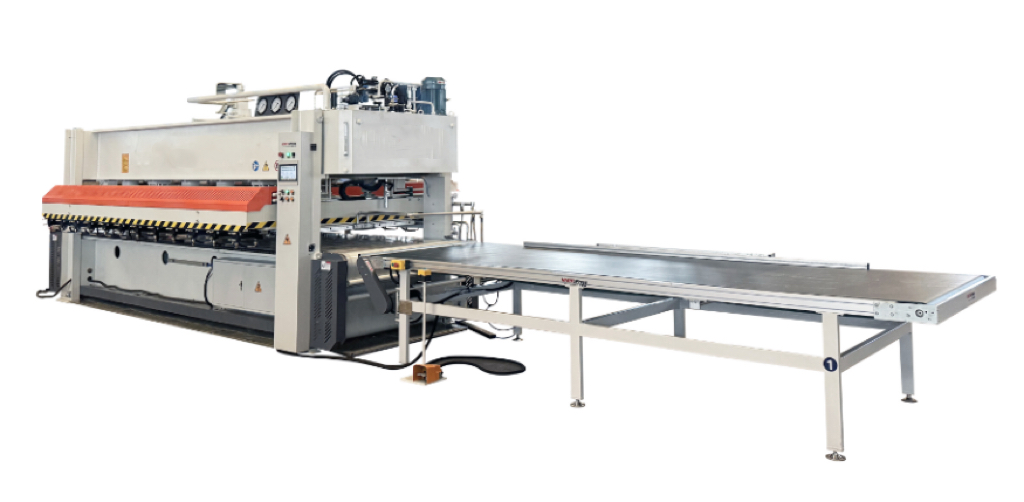
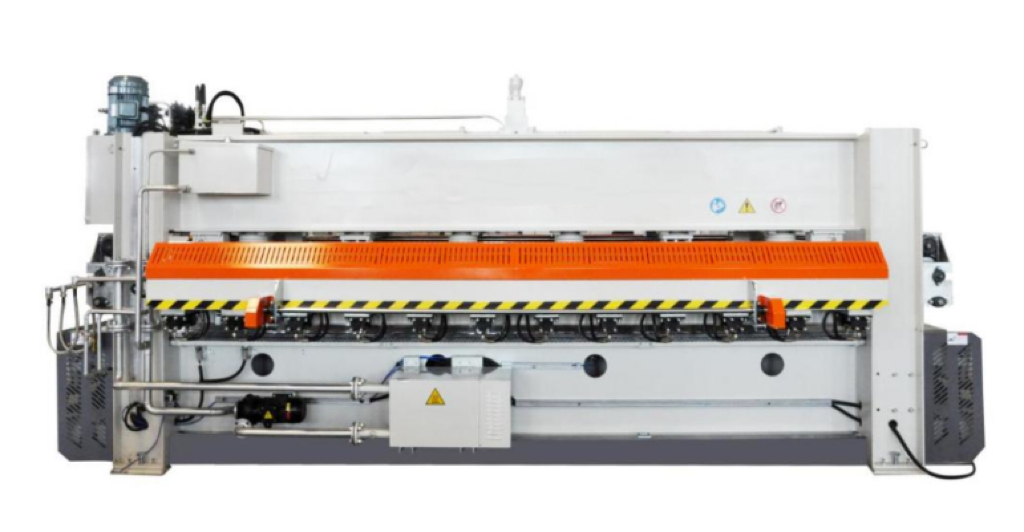
1. Stable Hydraulic Pressure: Utilizing a coordinated operation of the main hydraulic cylinder and side pressure cylinders, the main pressure can reach up to 1000KN, while side pressure assistance ensures uniform stress on the plate surface. Pressure can be flexibly adjusted according to material and thickness, fundamentally solving the problem of weak splicing.
2. Intelligent Temperature-Controlled Hot-Pressure Process: Equipped with solid-core deep-drilled hot-press plates, achieving uniform heating of the entire plate, with a maximum temperature of 120℃. The moisture content of the substrate is simultaneously balanced during hot pressing, significantly reducing the risk of deformation caused by temperature and humidity fluctuations.
3. Automated Production Line: The entire line is equipped with infeed and outfeed belt conveyors, achieving a fully automated process from feeding, positioning, pressing to output. The integrated PLC control system allows for one-click parameter setting, greatly reducing reliance on manual labor.
4. High hardness and flexible adaptation to various specifications: Supports splicing board thickness of 2-8mm, maximum splicing width of 1300mm and length of 3100mm, which can be flexibly adjusted according to production needs. It is suitable for high-precision splicing of solid wood, thin board and various decorative boards.
03 Advantages of Thin-Sheet Hot Press Splicing Machine
(1) Significantly Improved Splicing Quality
Through the synergistic effect of a high-precision hydraulic system and uniform hot pressing, the thin-sheet hot press splicing machine ensures constant gluing pressure and consistent temperature. This significantly improves splicing strength and solves quality problems such as exposed glue lines and cracked joints. Simultaneously, the wood moisture content is balanced during the hot pressing process, significantly enhancing the dimensional stability and deformation resistance of the finished product.
(2) Significantly Increased Production Efficiency
The single splicing time is reduced to approximately 2 minutes, and continuous operation is achieved through a fully automated production line. This breaks through the bottlenecks of traditional splicing relying on manual labor and long batch intervals, allowing for exponential capacity release, making it particularly suitable for standardized, large-volume order production needs.
(3) Intelligent and Easy-to-Use Operation
The integrated PLC control system simplifies the control of complex pressure, temperature, and time parameters into one-button operation. This not only reduces reliance on operator experience and shortens the training cycle but also avoids human error, ensuring a high degree of consistency in product quality across different batches.
(4) High adaptability and scalability
Its wide range of thickness and size adaptability (2-8mm thick, maximum width 1300mm) allows it to easily handle splicing tasks of various materials, from solid wood tabletops and wood door core panels to decorative veneer. This strong adaptability enables companies to meet diverse orders with a single set of equipment.
04 Conclusion
The upgrade of thin-plate splicing technology is not only an innovation in equipment, but also a significant manifestation of the shift towards intelligent and standardized production methods. The thin-plate hot-press splicing machine introduced in this article effectively solves the core pain points of traditional splicing, such as unstable quality, low efficiency, and cumbersome operation, through the systematic integration of hydraulic stable pressure application, intelligent temperature control technology, and fully automated assembly line operation. With the increasing demand for customization and the continuous improvement of production efficiency and quality requirements, this type of efficient, stable, and easy-to-operate splicing equipment is becoming an important support for furniture companies to enhance their competitiveness.
